"Simplicity can sometimes be more difficult than complexity."
Jobs would say that in his time at Apple, and at Graphpaper too, we often feel the same way as collections are developed.
When we take a look at clothing available in the market, there are often things that bother us.
Our uncompromising Director Takayuki Minami kept refining, testing, and rejecting
until he reached an oxford shirt he was satisfied with.
At first glance, it seems ordinary. But if you've ever felt the same tiny frustrations in shirts, this one might feel just right.
This is how Graphpaper Framework's unwavering standard was born.
Photographer: Junpei Fukushi
Text: Rui Konno

――You've been making this shirt for years. Let's revisit it. Is the fabric still your biggest focus?
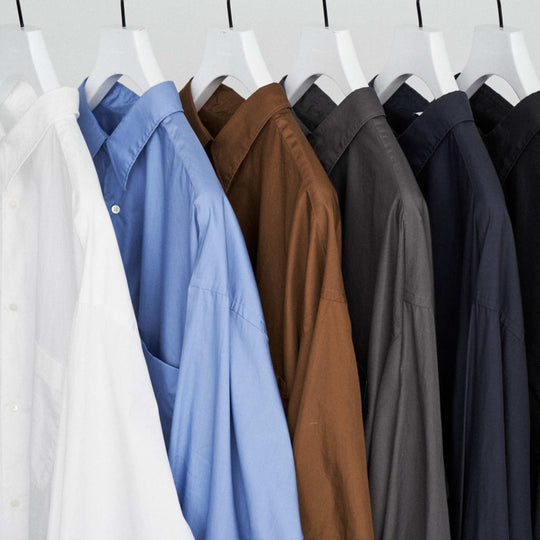
Minami: Yeah. Especially the thickness. When I decided to create a true standard, I looked at countless Oxfords — pin oxford, finer yarn, everything. You could easily make it expensive if you wanted, but that's not what I was aiming for. I love the thick American Oxfords like Brooks Brothers or Ralph Lauren. But Brooks leans too dressy for me. I wanted something rougher, thicker, slightly clumsy in a good way. That's when I found this fabric - especially this grey, which I'm keen on as it's quite rare.
――Was it a fabric the mill already had?
Minami: They had it, but the grey was slightly different, and eventually it was discontinued. So I told them, "We want to produce it properly as a custom order." The warp is black, and the weft is grey. Without that combination you can't get this depth of grey.
――Did you come up with the recipe?
Minami: No, I just said I wanted a grey Oxford, and the mill suggested it. Oxford cloth requires huge yardage, and when we were small, every fabric order felt like a life-or-death gamble (laughs). Changing the warp is especially tough because it affects the whole lot length. The original Oxford used white or black warp. They said, "White warp + grey weft becomes too pale. Black warp + grey weft might give the tone you're imagining." Weft is easier to change, so we tried it. I honestly thought, "Will this really work…?" (laughs) but the result came back and it was perfect — "Wow… this colour is amazing."

――The black warp gives it a charcoal-like tone.
Minami: Exactly. We often do this at Graphpaper - requesting a slightly different shade for warp and weft even when it's the same yarn. Our clothes are ordinary clothes, after all, so the material is what matters; the fabric determines 70–80% of the garment. For this shirt, the thickness and colour were everything.
――Grey Oxford isn't very common, is it?
Minami: It's usually white or sax blue. Of course Oxford is a traditional item, but if you're going to just recreate tradition, why not buy the original brands? So I think about what I dislike about them, and re-edit from there.
――Forgive me, but that's a bit of a mean streak (laughs).
Minami: Totally (laughs). I often see a shirt I want, then think, "If only this part was different." That's a consumer mindset. Framework's products contain nothing but my own subjectivity. There's no "for the customer" or "because the concept says so." It's only about whether I personally like it. If others agree and enjoy it - great.
――So it's not a case of sitting in a meeting room with marketing data and deciding what to make.
Minami: No. We don't hire research firms or read trade magazines. Even if statistics tell you something should sell, it doesn't guarantee a good garment. That's the fun of fashion. I feel Framework approaches clothing more as a product than as a designer exercise.

――How did you develop the silhouette and details?
Minami: Boxy silhouette. The collar and cuff construction are based on old Brooks. Body width and placket come from Ralph Lauren. It's a re-edited mix of everything I love. The pintuck on the cuff feels dressy, but wearable casually. The yoke on Ralph shirts is positioned much higher originally. I always wondered, "Why place it there…?" so we lowered it. A shirt was originally underwear - that classical idea may remain - but I personally dislike it (laughs).

――And it's big. Very big.
Minami: The body and sleeves are generously wide. We originally offered size 1 and 2. I was convinced size 2 would sell more. But actually, size 1 sold almost exclusively. I thought, "No one gets it… I want them worn big!" People weren't yet used to oversized silhouettes. I made size 3 just for myself because 1 and 2 felt small on me. Eventually size 2 began selling, then staff said, "Could be even bigger," and "Minami's size is the good one," so we started selling 3 as well. Now we have 1, 2, and F.
――The size grading is quite unusual.
Minami: Right. After 1 and 2 there's suddenly a larger jump. I wear F now, but our clothes aren't slim to begin with. Slim people start at 1 or 2. Today F is our best-seller.
――Nowadays oversized is normal. People are desensitized.
Minami: True. Our clothes have always been big, so early on it was hard to communicate. My gateway to oversized was old Comme des Garçons. In my twenties I bought them even if it hurt financially. But older men looked even better in them, so I stopped buying. Then when I reached the age where they should fit naturally, they felt tiny (laughs). Maybe their grading has gotten smaller too.
――Comme's size notation is also interesting — "SS" instead of "XS," or old menswear sizing still used today.
Minami: Yeah. And not just Comme - you still see "O" size sometimes. What does that even mean?
――Apparently it means "OVER LARGE," used in sportswear.
Minami: Oh really? Even size notation carries personality.

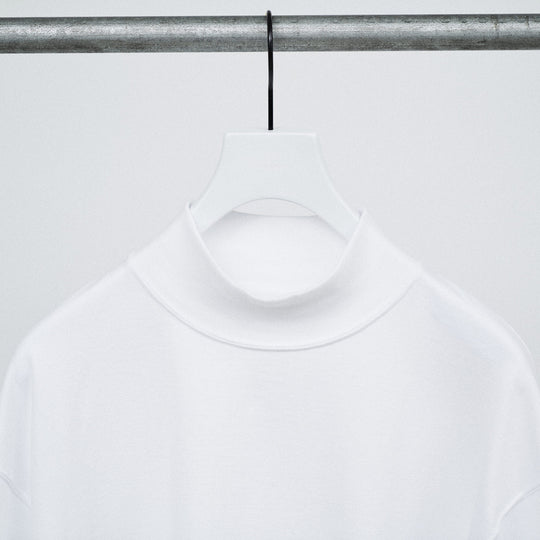
This is the band-collar model in the same fabric. Like the button-down, the shoulder slope is noticeably steep.
――Speaking of shape - beyond the size, the shoulder angle on this shirt is an unusual balance too.
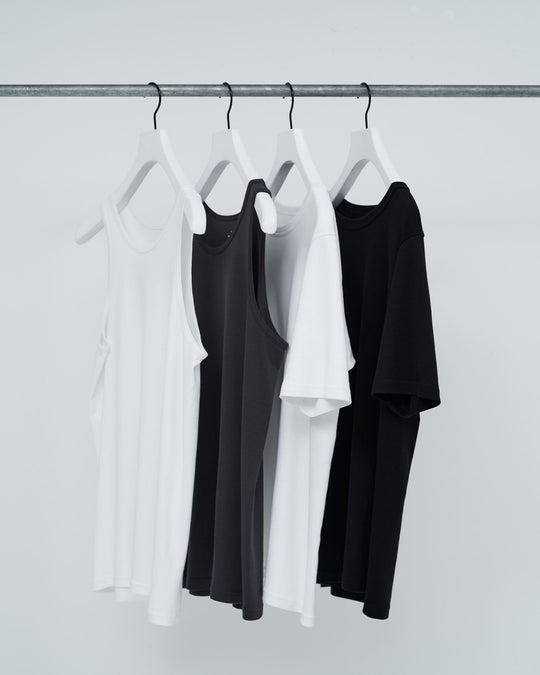
Minami: Yes. All Graphpaper garments share that steep shoulder slope. When slim people wear oversized clothes, the sleeve cap often pops up. I hate that. I wanted it to work even for sloped shoulders. Even our hangers have a subtle sloping shape. They hold both men's and women's garments because of that angle.
――I never noticed that (laughs).
Minami: Of course not. But some customers even ask, "Can we buy the hanger?" (laughs)

――True enthusiasts (laughs). Any other details you focused on?
Minami: Stitching. It's a casual shirt, but the sewing is full-on dress-shirt quality — the stitches are incredibly fine. Only a few factories can handle that. We searched and persuaded one to do it. The beautiful puckering on the flat felled side seams happens because of that stitch density. We aim for a balance between casual and dress.
――And it's garment washed, right?
Minami: Yes. Just one wash.

――Do you ever design with concepts like "for this type of person" or "reflecting this world view"?
Minami: For Graphpaper mainline, yes. But Framework isn't created that way. What I hated most as a consumer was loving a shirt and then visiting again only to find it gone. Being told "This season has a different theme, so we don't make that anymore" made me think, "What!?" (laughs) I wanted to wear that shirt this year, next year, the year after. I kept wondering if others felt the same - that's why I started this line.
――Most of us have felt that at least once.
Minami: If I were funded by a parent company maybe I'd have to consider many things, but I run both the company and brand myself. Success or failure is my responsibility. In the end, the only answer is making what I genuinely love.
――And if people don't connect with it, it won't work.
Minami: Exactly. Factories would get upset too. In the beginning I spent so much time apologizing deeply - almost groveling (laughs). "One day I'll make it work, please stick with us!" Those moments have decreased, but we owe everything to the factories - I feel nothing but gratitude. When someone loves a garment born purely from my subjective preference, I think, "Right? Exactly!" That feeling might be the biggest one of all.