
For Spring & Summer 2024, Graphpaper presents a collection themed around sumi (traditional Japanese ink made from soot and animal glue).
Shown alongside the clothing is the work of Daichiro Shinjo, the artist who served as a key source of inspiration for the season.
We spoke with Takayuki Minami and Daichiro Shinjo, each from their own perspective, about this new attempt at expression and presentation.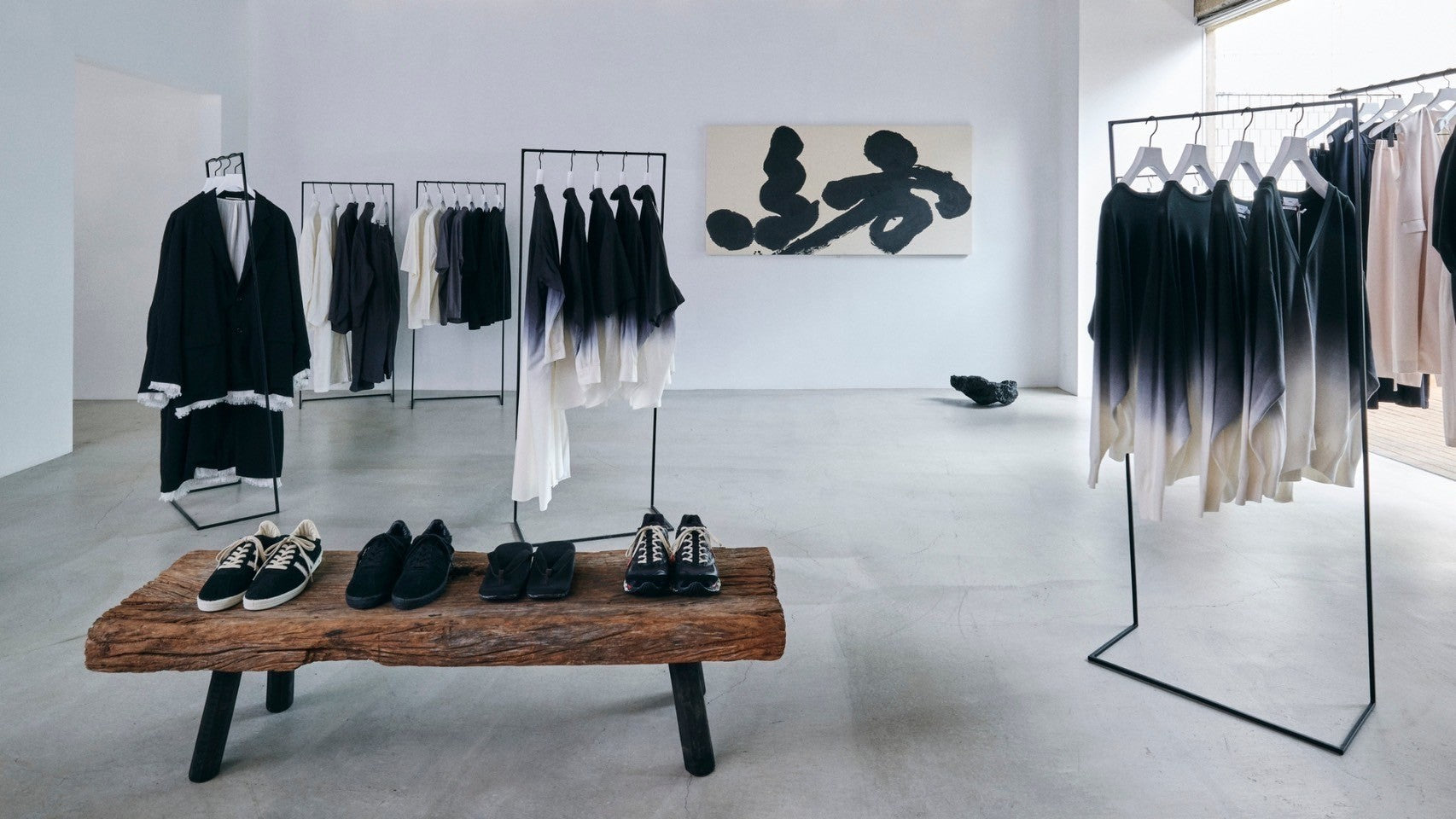
Presenting clothing and art together in the same space.
―This season's presentation feels notably different from what Graphpaper has done in the past.
Minami: There are so many brands today, each presenting their collections in their own ways. The most iconic example is the runway show, but Graphpaper isn't that kind of brand. I've long wondered whether there was another format that felt more authentic to us. This season, the concept permeates the entire collection, and everything comes together as if forming a single unified work. That led me to wonder - if we placed clothing inspired by sumi together with artworks created using sumi in the same space, perhaps the theme would resonate more strongly.
―Tell us about the artist whose work is exhibited here.
Minami: The works are by Daichiro Shinjo, an artist based in Miyako Island, Okinawa, who creates around the practice of calligraphy. While researching the ideas of "black" and "sumi," we were introduced through a mutual acquaintance. When I told him about the concept for the coming season, he invited me to his studio in Miyako. He showed me the difference between sumi he makes himself and commercially-made sumi, and I was able to watch his process. It was incredibly inspiring - he became one of the key sources of influence for this collection.


An artist who hand-makes his own sumi ink.
―How did this exhibition come about?
Daichiro Shinjo (Shinjo below): We first met last year when I held an exhibition in Kyoto. I had worn Graphpaper before, and of course I already knew of Minami. He had the concept for this upcoming collection in mind, and it seems he had visited my exhibition to see the works firsthand. When we spoke, he told me he was interested in sumi. I've been making my own sumi for about three years now, so I suggested he come and see the environment and process behind its creation - and that's how it began.
―You can make it yourself?
Shinjo: You can - though it's rare. At first, I bought ready-made ink, but both solid sumi ink blocks and liquid sumi are expensive, and I tend to work in large formats, so I get through a lot. I decided to try making it myself, sourcing soot and animal glue from a manufacturer in Mie.
―So your artmaking begins with making sumi?
Shinjo: Yes. And once I started, I found it fascinating. Commercial sumi is convenient, beautifully balanced, and consistent, but handmade, it carries a natural irregularity that I find deeply attractive. The commercial-type contains preservatives, while mine is fresh and perishable - it literally goes bad over time. It can't be stored long, but in exchange it has a vivid energy. Working this way also means I spend more time confronting the material itself, which strengthens my connection to each work. The color is only black - unlike oil painting or sculpture where accumulation builds depth over time. Because the expression is so minimal, I think truly facing the material is essential. That is what gives the work its force.
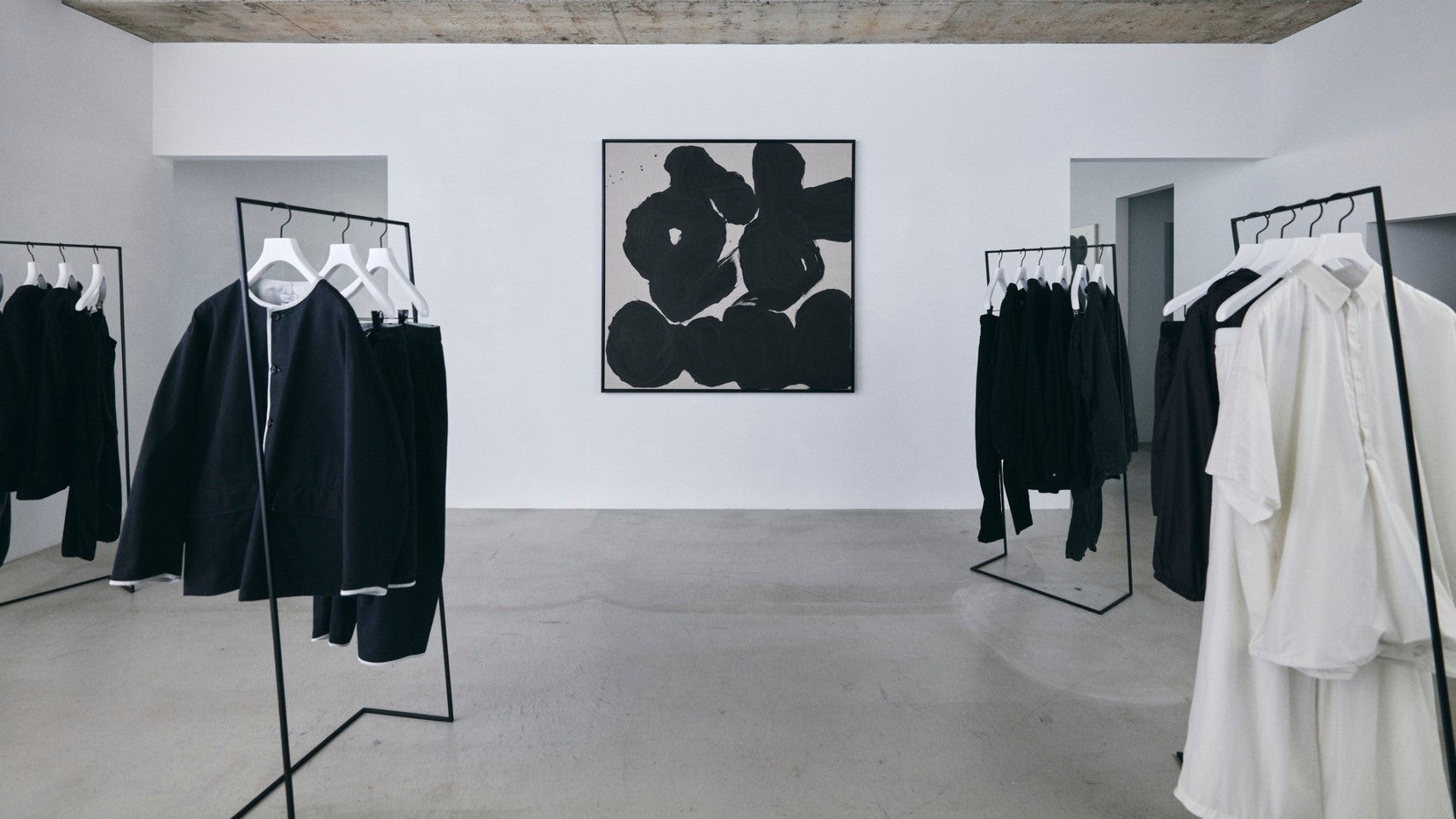
―The bold brushwork and composition catch the eye, but looking closely, the density and volume of the black varies greatly.
Shinjo: The animal glue is made by simmering animal hides, tendons, bones, connective tissue - from deer, cows, rabbits, etc. Soot alone won't adhere to paper, so glue is mixed in for viscosity. It's so strong that the tension can warp a canvas. The pull is difficult to quantify or control. But increasing glue content produces thicker, more dimensional strokes and deeper black. I am constantly experimenting.
―The canvas and paper you work on are also special?
Shinjo: The canvas is linen. I move the brush slowly, almost as if dyeing the surface. The paper is hand-made hemp washi, highly absorbent. If I write quickly, everything becomes faint, so I allow the ink to sink in slowly. It's an incredible material, but washi production faces decline due to reduced demand and a lack of successors. It may disappear in the near future. It's expensive, but I use it carefully - hoping it survives.
―Could you explain the motifs of your works?
Shinjo: The smaller works depict the character 美 ("bi", meaning beauty). It's a motif I often use - like two people embracing. Though flat works, for this project I imagined sumi becoming clothing, something worn on the body.
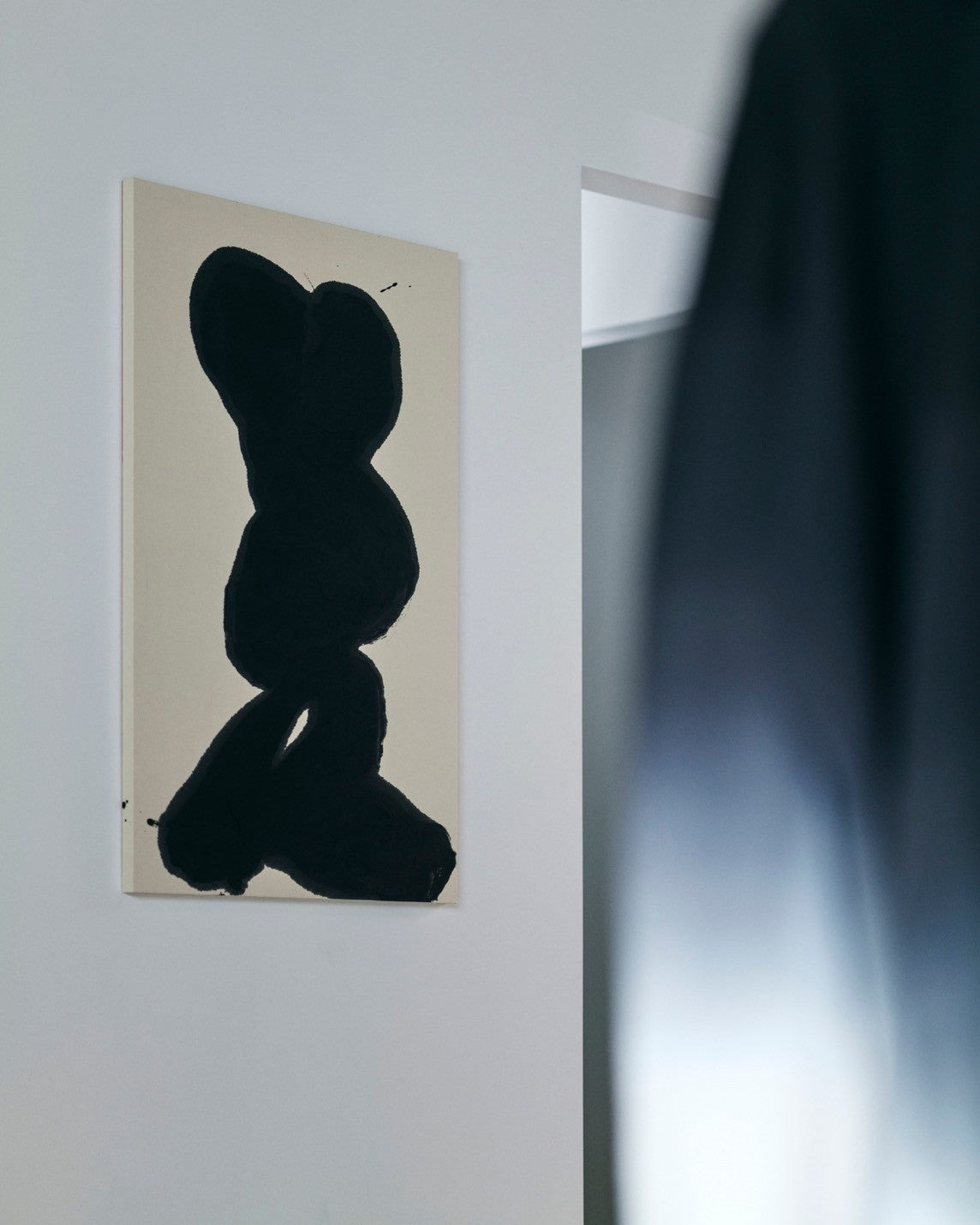
UNTITLED, 2024
Sumi ink on paper / Motif 美
Hemp paper 970 × 620 mm
Shinjo: When pursuing sumi, I eventually became aware of the spaces between black. Watching black means watching white at the same time. I see black as zero - as 空 ("kuu", meaning emptiness). How can something other than emptiness emerge within it? I believe Minami was also thinking about landscapes seen from within black, so I chose kuu as another motif.
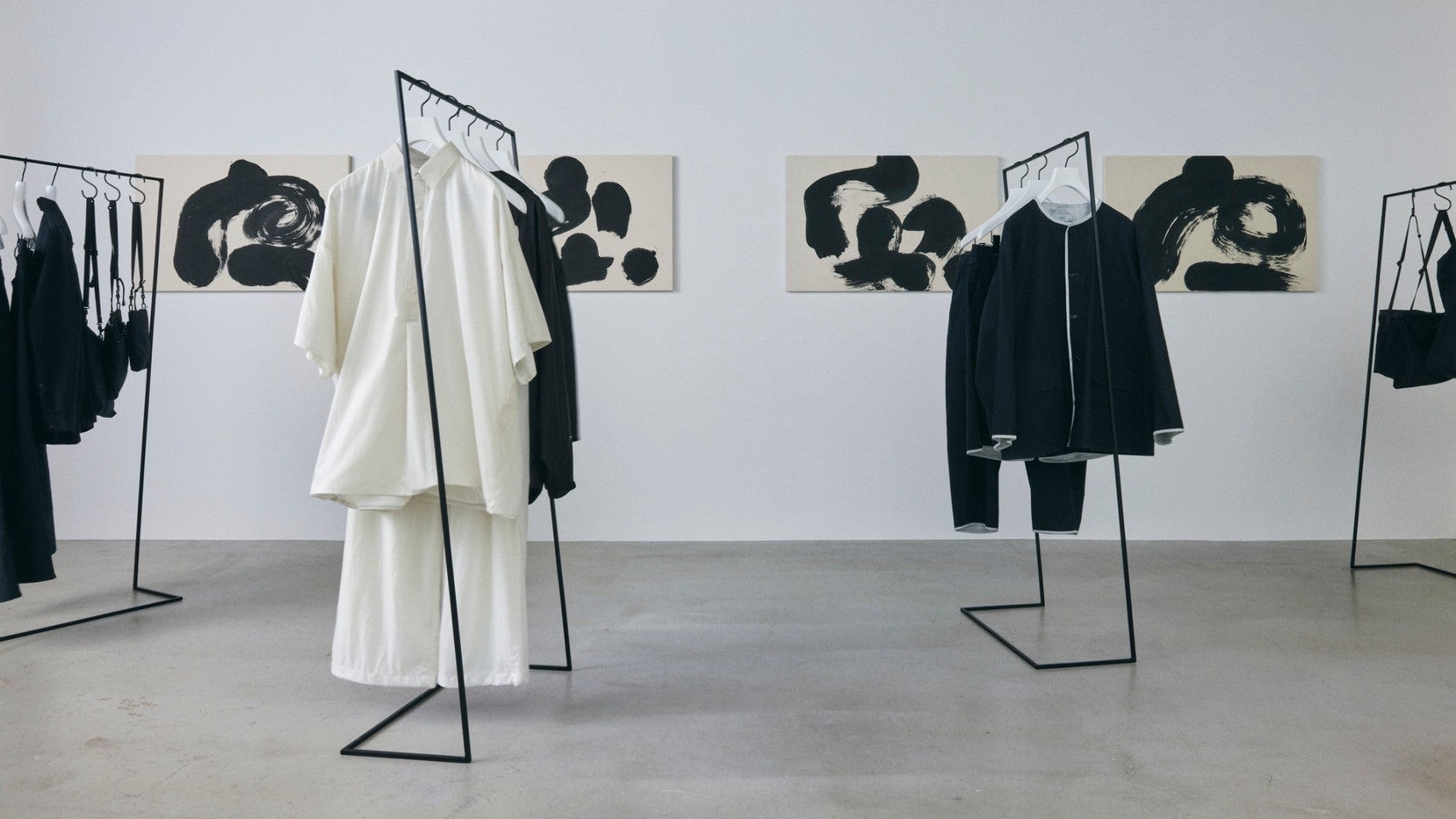
UNTITLED, 2024
Sumi ink on paper / Motif 空
Hemp paper 620 × 970 mm
Shinjo: The large work is the old form of 點 ("ten", meaning point or dot). A black point - but it could be a hole, or a circle, or a sphere. It invites interpretation, a Zen-like inquiry.

UNTITLED, 2023 (with frame)
Sumi ink on linen canvas / Motif 點
Canvas size 80
1500 × 1500 × 45 mm
Shinjo: 紡 ("tsumugu", meaning spin or thread) was written impulsively on the final day of production. I imagined garments spun from black thread, lined along the space.
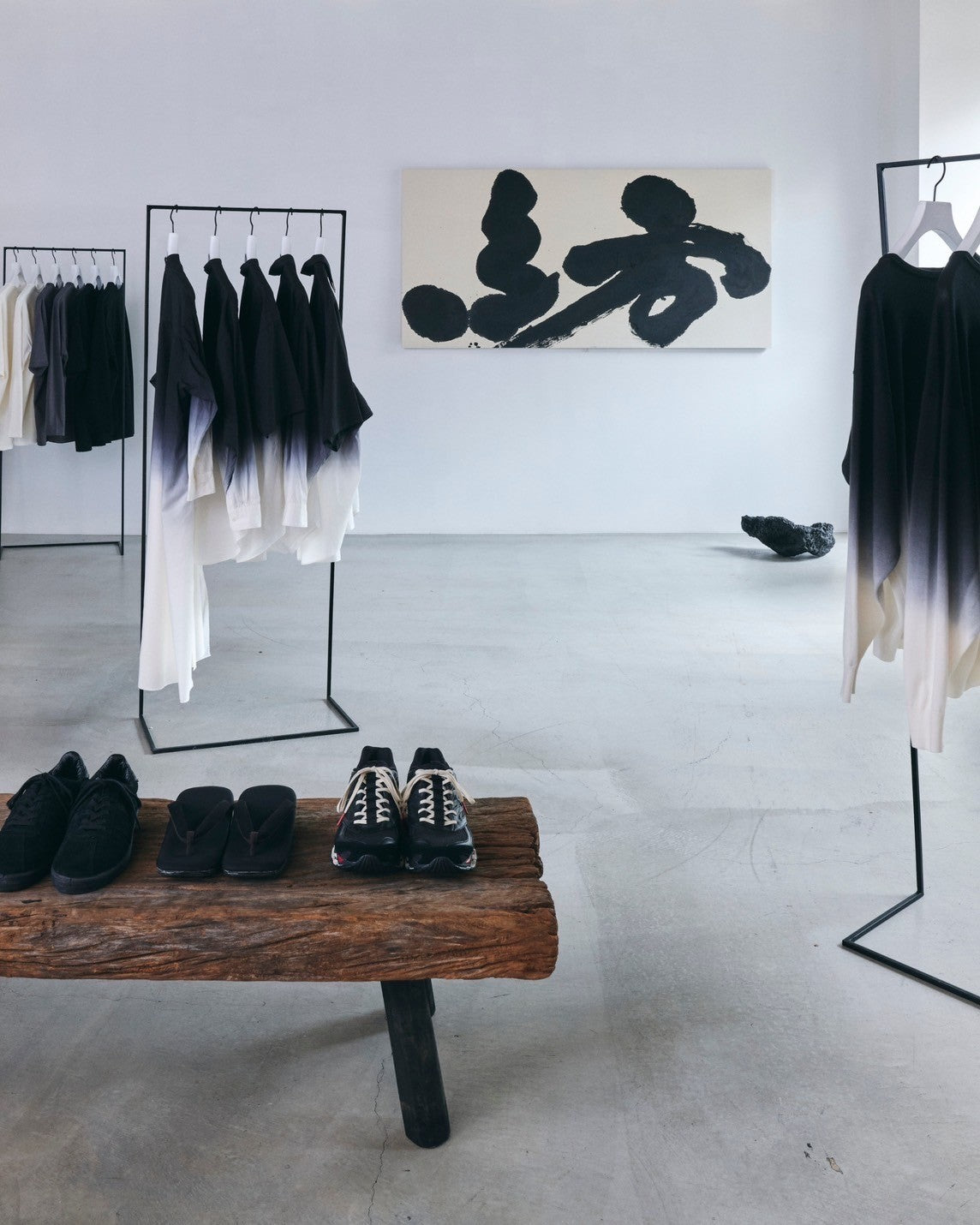
UNTITLED, 2024
Sumi ink on paper
Motif 紡 / Hemp paper
940 × 1940 mm
Shinjo: For the black-on-black work, I first dyed the linen canvas in diluted sumi to create a black background, then wrote 在 ("aru", meaning existence) over it in thick ink. Depending on the angle, black appears within black - I wanted to create depth inside darkness.
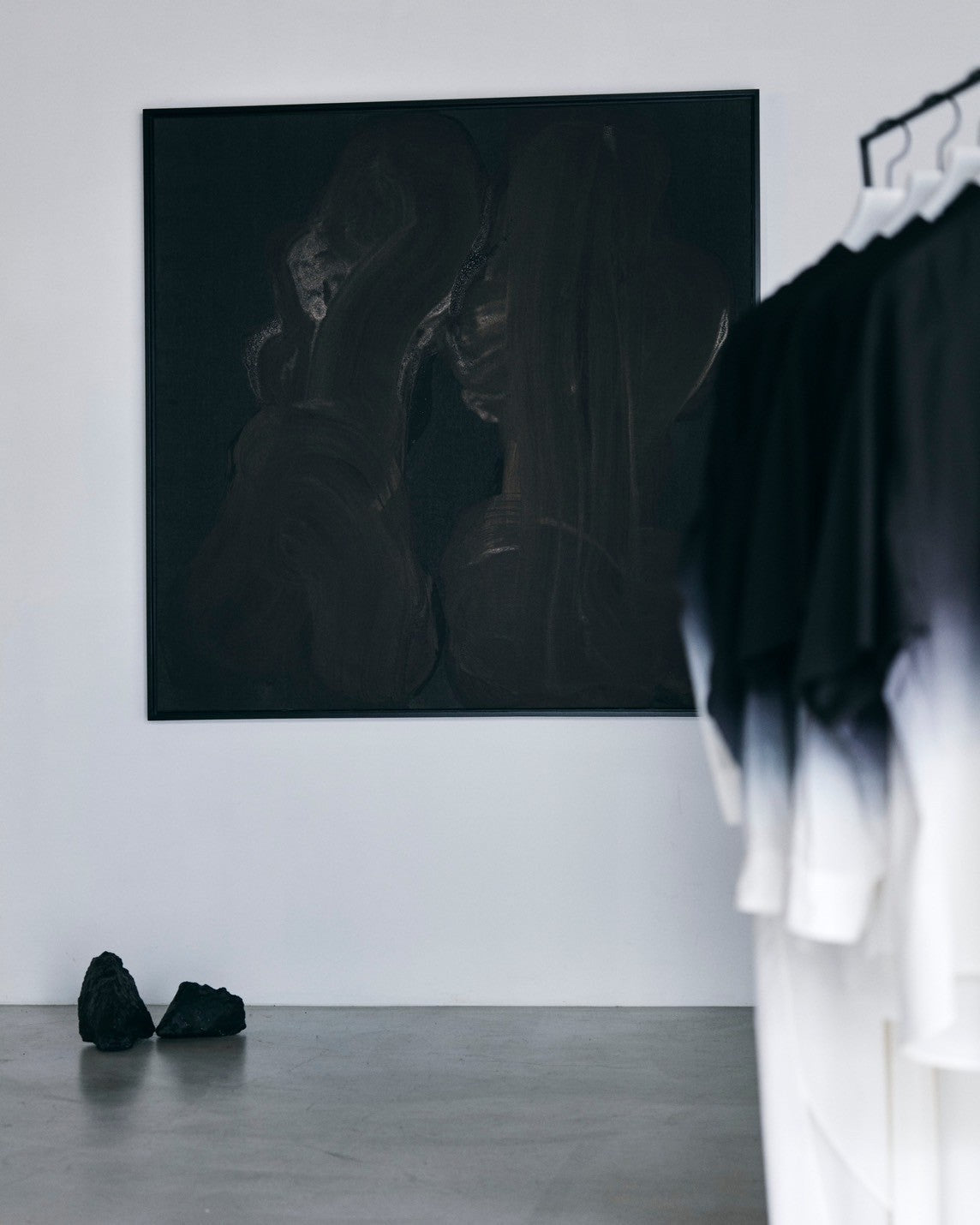
UNTITLED, 2024 (with frame)
Sumi ink on linen canvas
Motif 在
Canvas size 80
Embracing natural imbalance.
Shinjo: Dense areas crack as they dry. That's often seen as undesirable, but to me it's natural - even beautiful. I leave it as is.
―Is that because you use handmade sumi?
Shinjo: Commercial sumi, balanced with additives, prevents cracking. But I want to affirm imbalance. Each piece has character, a nature of its own. I want to create works by accepting that individuality.
―The idea links beautifully with Graphpaper's 2024 Spring & Summer Collection. The reason your work and the garments are shown together feels much clearer now.
Shinjo: Minami never asked me to create anything specific - our relationship is built on trust. Working with sumi is what I always do, and my pieces weren't meant to become garments, so I could approach the work freely and smoothly. Minami traveled all the way to my studio and stayed for a long time - we could exchange our sensibilities face to face. He understood my expression. That said, I make sumi for my own work; I'm not a professional ink maker. If he had gone to a long-established traditional ink maker instead, the outcome might have been completely different.


