Director Takayuki Minami has created what he's been seeking from denim, resulting in Graphpaper's now signature denim for adults who value familiarity and comfort. When compared to other brands, the difference lies in the thinking behind it.

Until now, Graphpaper's standard denim offerings were styles that combined five-pocket jeans with slacks - designs that did not emphasize vertical fading. Recently, however, Minami found himself once again drawn to wide five-pocket denim. It was something he started wanting to wear himself, so he decided to make it.

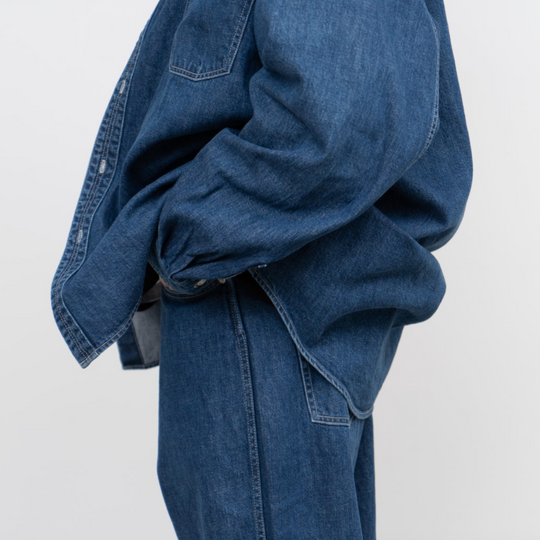
He was thinking about whether it would be possible to create a clean version of a 1990s workwear look - old Levi's work shirts, 501XX jeans, and Red Wing boots. At the time, very exaggerated silhouettes were common, but personally he prefers a tapered shape. With that in mind, he carefully considered the pattern, giving the jeans width through the thigh and gradually narrowing them toward the hem, updating the silhouette for a contemporary balance. And, in the past, heavier denim around 13 to 13.5 ounces felt right. But as you get older, those kinds of garments simply become harder to wear - they're heavy, and you stop reaching for them. So this time, the denim is 10.5 ounces - lightweight, yet with the firm, dense appearance of vintage selvedge denim. Gray is a particular favorite: black warp threads combined with gray weft threads create a great color expression, and the overall fading should come out clean and balanced.
The baggy version features an elasticated waist. Minami has always liked the kind of half-length shorts worn by skaters in the 1980s - brands like Stüssy - and wanted to revive that feeling by simply scaling it up. Both silhouettes serve as an homage to periods when American casual and street culture were riding a workwear boom.


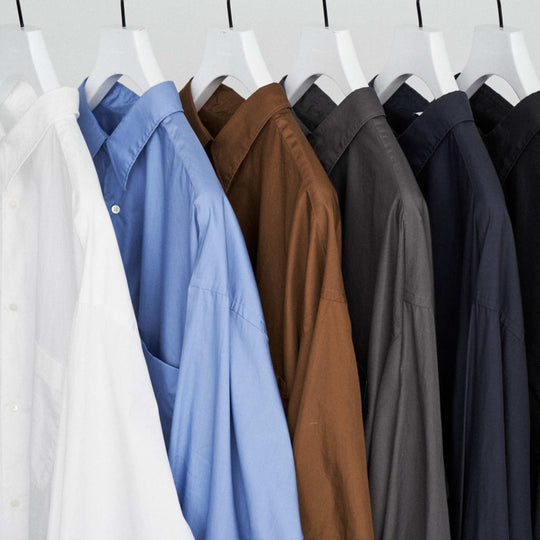
The shirts are based on actual vintage Levi's designs, but the sizing, shoulder angle, and overall silhouette have been adjusted to suit Graphpaper's proportions. The original garments had a lot of stitching, which felt visually heavy, so it was reduced. Instead of the typical golden-brown thread, light gray is used on indigo, and ecru thread on gray and black, giving a cleaner, more modern impression. While the placket stitching follows traditional work-shirt detailing, the top closure was changed from a tack button to a shell button. The original is extremely difficult to fasten, and the metal adds unnecessary weight.

Denim that looks substantial without actually feeling heavy is surprisingly rare. Lightweight denim tends to look thin, so this was pushed right to the limit. The fabric appears dense and weighty in color, yet in reality it is light, easy, and comfortable to wear. This was especially important for the elastic-waist baggy pants - if the fabric is too heavy, they simply slip down. Since these are, at their core, shirts and trousers, wearability was prioritized.

Another point lies in the construction. Typically, denim trousers are sewn with flat-felled seams only up to the pocket area, switching below that point to a split seam so the stitching doesn't show. At Graphpaper, the flat-felled seam continues all the way down, like military or chino trousers. One of Graphpaper's signatures is showing the stitching from waist to hem. While split seams reveal selvedge when the hem is rolled up, Minami wanted to show the stitching rather than the selvedge - he'd always felt you might as well sew it flat-felled the whole way rather than splitting it. It's a detail many people won't notice immediately, but it's rare and becomes a subtle point of interest, which is what makes it cool. Many brands want to follow the original models and insist on selvedge, but this is not about making replicas. He simply prefers this approach.


There are plenty of brands that thoroughly pursue the essence of denim, and Minami has no interest in competing in that space - if he's not wearing that kind of thing himself right now, he has no interest in it either. If you want something that obsessive, you might as well buy vintage. This denim is aimed at people who like denim but feel that something has been missing - or who have gotten older and no longer want heavy, rigid jeans they have to "raise," yet still find themselves thinking, "this one's good." As stated in the brand's concept, Graphpaper aims to create clothes for people who have worn many things and arrived at their final choices. Ease, comfort, and wearability come first, but there must also be ideas that those in the know will recognize. The same goes for the selvedge - saying it isn't necessary doesn't mean ignorance, and he wants people to understand it isn't made by someone who doesn't know clothes. It's a deliberate choice, made after full understanding, not to do it.