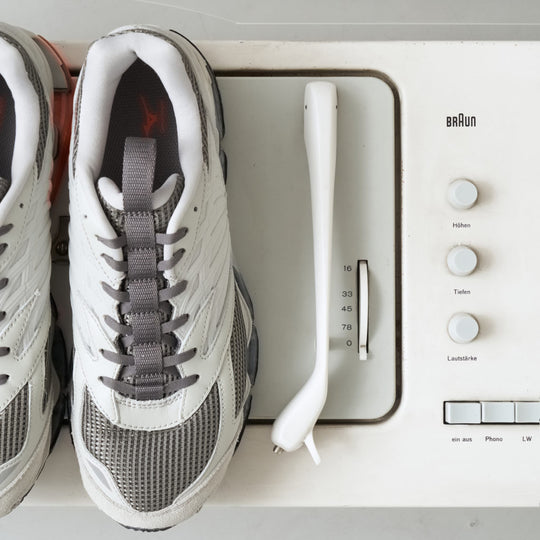
From the 2021 Spring & Summer German Military Trainer to several seasons of ongoing collaboration, Graphpaper has worked closely with REPRODUCTION OF FOUND. We spoke with Graphpaper director Takayuki Minami about what drew him to the brand's philosophy of "finding and reproducing," and the uncompromising approach to craftsmanship that underpins their work.

――How did you first come across REPRODUCTION OF FOUND?
Takayuki Minami (hereafter, Minami): It was in Paris, wasn't it?
REPRODUCTION OF FOUND (hereafter, R): A few years ago, we were exhibiting at MAN Paris (an international fashion trade show). I was taking a break outside the venue when Minami happened to sit down next to me. He casually asked if we could make shoes for him. That was how it started.
Minami: At first, I honestly thought he wasn't the brand owner - I assumed he was a Japanese agent selling products for some overseas factory. But as we talked, he said, "No, we do everything ourselves." And I remember thinking, that's crazy - in a good way. That's cool. I was already looking into making sneakers at the time, visiting factories and exploring options, but nothing really felt right. Everything ended up being some kind of imitation - "this-but-not-quite" versions. Then I came across REPRODUCTION OF FOUND and thought, if we make something together, this could get interesting. That was the moment.

――What exactly felt so compelling to you?
Minami: For me, it was the fact that they deliberately tracked down factories in places like Slovakia and Romania - factories that originally produced military sneakers - and insisted on manufacturing there. Most brands just make something that looks the part in China, but frankly, a lot of that work isn't very good.
R: We still can't fully explain it in technical terms, but the understated feel and delicacy we're after can only be achieved at the factories we use in Romania and Slovakia. We've tested production in China and other countries using the same materials and patterns, but the results were never the same.
There are many factories across Europe that once made military sneakers, so we continue researching and visiting them when we travel. Even with German trainers, several factories had produced them historically - but none delivered a finish that felt as right as our current Slovakian factory. Even when everything is technically identical, there's a difference in feeling that's hard to put into words. I think the same applies to Minami's clothing. A T-shirt can be made anywhere, but some things can only be made there. That shared sensibility - caring about where and how something is made - is probably what connects us.
Minami: Of course, it also comes down to taste.
R: Exactly. This is what feels right to us, but some people might prefer something cheaper, made in China.
――Why did you decide to start a brand focused on reproducing military shoes in the first place?
R: From my twenties onward, I spent over a decade working at a select shop dealing in European vintage clothing. I handled buying and sales, and that meant traveling extensively - visiting warehouses around Europe and the world to source military items. I saw countless military shoes from different countries. The details were fascinating, but many were dirty, poorly balanced, or badly sized. They were great references, but hard to sell as products. That stayed with me. Eventually, I thought: what if we updated these designs for the present day and turned them into a dedicated shoe brand? I love shoes, and there wasn't really a brand focused solely on modernizing footwear. It was an exciting concept - wondering what would happen if we did it ourselves - so we decided to step in and commit to it properly.
――What was the first item you collaborated on with Graphpaper?
Minami: It was ZDA.

2018SS Collection / ZDA for Graphpaper "Marathon Trail"
R: We actually run two brands. One is REPRODUCTION OF FOUND, which focuses on military shoes. The other is ZDA - a Slovakian local brand that existed until around the 1980s. When we launched REPRODUCTION OF FOUND, the Slovakian factory we work with still owned the ZDA trademark and had the equipment and know-how from back then. The owner suggested we try reviving it. When I saw the archives, there was something indescribably awkward, almost charmingly crude, about them. So we decided to run both brands in parallel. Our first collaboration with Minami was through ZDA.
Minami: "Awkward" is one way to put it - it's pretty untrendy, really. We first collaborated on ZDA in SS18, then did a few exclusive models, and finally moved on to the German Trainer in SS20. This 2021 season marks the second iteration. The first time, we referenced the work of minimalist artist Carl Andre and added silver lines as highlights. This season, the theme is focused on the work of Isamu Noguchi.
What makes me happiest is that some customers are still wearing those first ZDA collaborations. It's hard to describe what kind of sneaker it even is - they're simply low-tech, almost the kind you might imagine being dumped in a discount shoe store for older men. It's right on the edge. But the fact that they're made with total sincerity, that's what's incredible.

R: And even the name "ZDA" - what is that, really? Yet for a shoe like that, we go to the trouble of sourcing high-quality materials from Italy. The originals were crude, so materials are essential to raising the overall quality. We keep the original atmosphere but decide the colours ourselves, upgrade materials, and even commission fine 100% cotton laces from a Czech manufacturer with over 200 years of heritage. The outsole uses an original mold dating back to the Czechoslovak era - once used for marathon runners. We preserve what's good and carefully update only what's necessary, right up to the edge of what can be changed.

For example, this Romanian-made vulcanized model - similar to the origins of Converse or Vans - is entirely handmade. An elderly factory worker still cuts the rubber by hand. Whether you accept that imperfect charm or not is a personal choice. But there's a quality here you can't find anywhere else. Normally rubber contains only 20–25% natural rubber, and the sole cracks after long wear. Here it's 80% natural rubber, so it's incredibly flexible and comfortable. We've also upgraded the cushioning ourselves, with a high-rebound EVA midsole and a reworked insole.

2019AW Collection / REPRODUCTION OF FOUND for Graphpaper "US Navy Military Trainer"
Minami: That's the amazing part. Low-tech shoes usually destroy your feet after a long day - I can't wear Vans anymore - but these have a properly built insole and are genuinely comfortable.
R: Only our current factory can achieve that blend. There are plenty of places with good rubber quality and technical skill, but somehow they can't produce this particular feeling. The insole, though, was something we requested. As Minami said, you put them on in the morning and by around one in the afternoon your feet are tired, so you stop wearing them. We asked the factory to solve that problem, and they came back proposing a new insole construction themselves.
Minami: It's an invention. You know the moment you put them on.
――That Slovakian factory clearly has deep expertise.
R: Right. The owner loves researching materials. The ownership has changed along the way, but the factory has a long history - it once produced shoes for major European sports brands. The equipment hasn't evolved much since then. They occasionally try to modernize, but our brand prefers hand-stitching over automation, so we ask them to keep working as they do now. This is our sixth year as a brand. Our goal is to preserve that old-world character while carefully updating it. They aren't cheap sneakers, but we hope people enjoy those subtle differences.

――And those subtle differences carry into this season's German Trainer collaboration too.
Minami: Helmut Lang made a German Trainer, and Ludwig Reiter, the long-established brand that was popular in the '90s, released a reproduction at the time as well. To me, the German Trainer is a universal, already-completed sneaker design. So I deliberately saved a Graphpaper version for later, and started with the more idiosyncratic, unusual models first. If you're going to touch a design like this, you need real resolve - which is partly why I avoided it.
A completed design doesn't need altering, and if you mess with it carelessly it instantly becomes pointless. About the only thing you can do is change the sole colour, and that requires a substantial production run. So I thought we'd wait until customers had grown familiar with us. This time we had them make the sole in an original colourway, and beyond that just adjusted the colour combination slightly. I wanted to avoid doing anything unnecessary - which is exactly what made it so difficult.

――Within those constraints, where does Graphpaper's identity come through?
Minami: Primarily in the custom outsole colour, and then in details like the lining and insole colours. The overall palette reflects the grey of this season's Graphpaper theme.

R: For the exclusive model, matching the sole colour was the hardest part. We weren't simply told "charcoal grey" - we were shown a cut piece of fabric and asked to produce that grey. The sole maker then has to dye it themselves, so reproducing the charcoal grey Minami had in mind took an enormous amount of work. The design was already complete to begin with, but what I felt through collaborating with Minami is how skilfully it's differentiated right at the very edge. While we're making it, it isn't always clear. But when we visit the exhibition and see the collection as a whole, it often clicks - so that's what it was about.

――How do you update a shoe whose design is already this resolved?
R: Original military versions used compressed scrap leather with a film coating on the surface, and a slightly brushed fabric at the collar. The design is simple, so we focused above all on the quality of the materials. We sourced soft Italian nappa leather for the base, cow suede for the toe, and pigskin lining from Germany.
Minami: That's exactly how we think at Graphpaper. If you're making something ordinary and the texture feels cheap, you may as well just buy what already exists.
R: So many brands use this as their source, so the question is how we can approach it in our own way. We have many other styles, and the thinking differs by item, but with the German Trainer in particular we're most particular about materials.
Minami: It really is a complete standard. But just by raising the quality of the materials - because the underlying design is good - it somehow looks properly considered. I feel like it goes with anything, and I think I understand why everyone, especially Europeans, makes this shoe.

――Is there a guiding principle when deciding what to "find and reproduce"?
R: There's no shortage of source material, but we never know how it will turn out at our current factory - so what matters is whether the source fits the factory's techniques. We started with military shoes from four countries: Germany, France, the UK and Canada. Before we knew it, the number had grown enormously. But we aren't fixated on country of origin so much as shape and design, so these days we even research and produce things from the 2000s.
――So you aren't fixated on era either?
R: That's one possible approach, but it isn't ours. We aren't especially interested in something having value simply because it's vintage.
Minami: It's about how you reproduce it - it isn't a reissue.
R: We never sold ourselves on how closely we could approximate a vintage look, so early on people would sometimes ask us to show the original for comparison. But that isn't what this is. It's about what you find, and what you can do with it through your own interpretation. We select the most suitable materials we know of for each item, and pour them into these simple sneakers.

Minami: Sneakers tend to drift toward a high-tech feel, don't they? Something like the Mizuno Wave Prophecy is a concentration of the latest technology - about how fast you can run, how light it can be. I find it interesting that the complete opposite of that exists within Graphpaper. You couldn't ask Mizuno to produce the atmosphere of a German Trainer, and I wouldn't want them to. That analogue quality can only come from REPRODUCTION OF FOUND.
My concept of menswear - of my own fashion - is that you take a base garment and work out how to make it usable in contemporary city life: updating the materials, changing the combinations, mixing relationships between countries as an act of editing. So when it comes to footwear, it ends up being either high-tech, low-tech, or an uncool shoe. I don't need anything else. The low-tech is made over here, the high-tech over there, and that mix is what's interesting. In fact those are all I own - fundamentally, I don't want to wear a shoe that sits somewhere in between.
――So that kind of uncoolness from the first ZDA collaboration isn't something you could create with today's sensibility.
Minami: You couldn't. It belongs to the feeling of that era, and it comes from being made in that country.
R: When we first met in Paris, your opening line was, "Could you make me an uncool shoe too?" (laughs) Though I took it as praise, in your own way.
Minami: It was praise. Even when I go abroad to buy, I'm sometimes hunting for uncool things, so I'm always saying "that's so naff" - if they understood Japanese they'd probably be furious (laughs). Uncoolness isn't something you can produce on purpose, and I like things that go all the way, so it inevitably ends up that way.

Released Saturday, March 13 — REPRODUCTION OF FOUND for Graphpaper German Military Trainer
<Profile / Brand Introduction>
REPRODUCTION OF FOUND
Founded in Spring/Summer 2016, REPRODUCTION OF FOUND is built on the concept of FOUND and REPRODUCTION. Its military trainer series is handmade, one pair at a time, in factories in various countries that produced large numbers of military training shoes between the 1950s and 1990s. The logo and tags state the product name, country and era, disclosing the design source. Focusing on military items, the brand finds timeless, universal pieces and reproduces them for the present day.