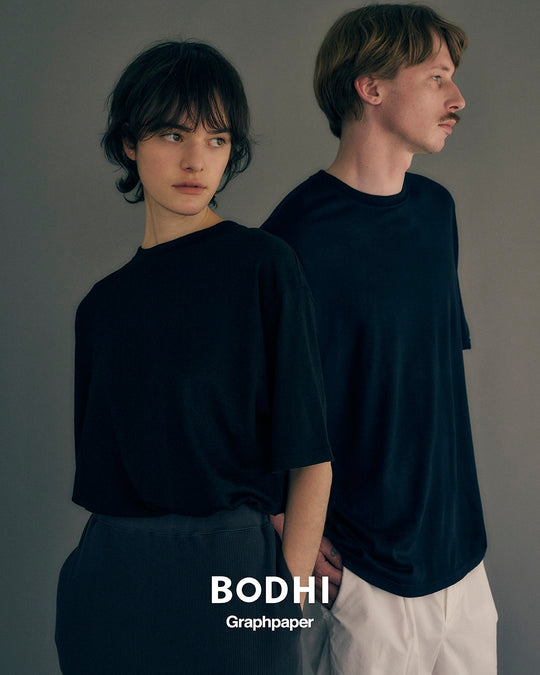
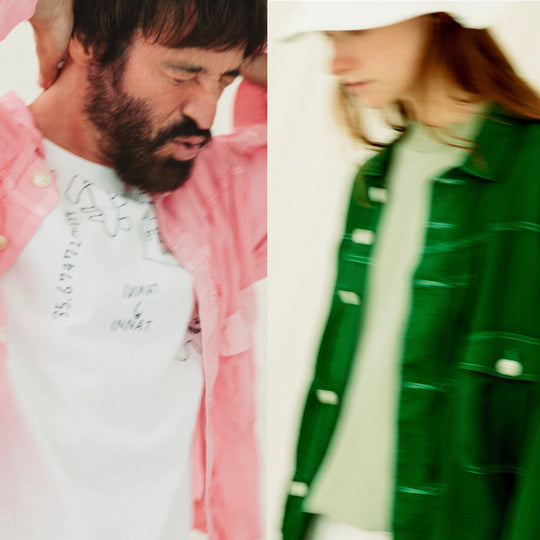
Graphpaper minus “REPRISE” revisits fabrics used throughout Graphpaper’s past collections through a contemporary lens, reimagining them and proposing new value in a new context.
Together with Kanai Kogei, an atelier based in Amami Oshima, we introduce a new lineup developed through natural dyeing, available from Saturday, August 29.
Rather than adding something new, the project turns its attention to what already exists, bringing out its untapped potential. Here, we explore the ideas behind this initiative through the shared approach to craftsmanship found in both Graphpaper Minus and Kanai Kogei.
Starting Saturday, August 29, the new lineup available at Graphpaper Conservatory looks to the archives that Graphpaper has carefully preserved, selecting pieces across different silhouettes and materials, including shirts, knits, cut-and-sews, and dresses.
As a way of adding new value to these existing pieces, we turned our attention to natural dyeing—a process that draws color from materials already found in nature, such as plants and soil.
Rather than creating garments from new fabrics, the process begins with garments that already exist.
The colors layered onto them are likewise drawn from elements already found in nature.
For Graphpaper Minus, which considers everything behind a garment as part of its design and gives form only to what is necessary, turning its attention to what already exists and discovering its potential is another way of approaching craftsmanship.
Natural dyeing using materials found in nature is also an experimental process, in which the resulting colors vary depending on the materials and environment at any given time. Rather than controlling every element to achieve a predetermined result, it embraces the unexpected outcomes that emerge along the way.
This approach also resonates with the way Graphpaper has approached craftsmanship throughout its collections.
The natural dyeing for this project was carried out by Kanai Kogei, based in Amami Oshima.
With its mountainous terrain and ancient geological layers, Amami Oshima is home to mud rich in iron, formed as iron from beneath the ground accumulates in the island’s mud fields. At Kanai Kogei, tannins extracted by boiling sharinbai, a plant native to the island, are reacted with the iron in this mud to bring out complex, deep tones.
Turning not only plants and mud, but also the geological layers and water behind them, into color means transforming the natural environment of the land itself into something tangible.
At the same time, it is about carefully understanding the condition of each natural material and the characteristics of the fabric being dyed, and drawing out the color that lies within.
In Kanai Kogei’s approach to craftsmanship—engaging with what already exists and bringing out its potential—we found a shared philosophy with Graphpaper Minus.
This project employs three natural dyeing techniques: indigo dyeing, indigo mud dyeing, and mud dyeing.
Rather than dyeing every piece in the same way, each method was selected based on the original materials and colors of the respective archive pieces, bringing out their individual character.
Indigo dyeing creates green and blue, indigo mud dyeing produces black, and mud dyeing creates brown. Through the combination of the original garments and natural dyeing, four distinct colors emerge. Indigo Dyed
Silicon Poplin Deep Slit Regular Collar Shirt
Price : ¥46,200 incl tax / Color : GREEN / Size : 0
Brushed Mockrody High Neck L/S Tee
Price : ¥35,200 incl tax / Color : BLUE / Size : 2 Indigo × Mud dyed
Suvin High Gauge Knit Cardigan
Price : ¥66,000 incl tax / Color : BLACK / Size : 1
Cotton Pique Jersey L/S Skipper Polo
Price : ¥48,400 incl tax / Color : BLACK / Size : 2 Mud dyed
Silk Noil Viscose Sleeping Shirt
Price : ¥55,000 incl tax / Color : BROWN / Size : 2
Brushed Mockrody High Neck Dress
Price : ¥44,000 incl tax / Color : BROWN / Size : 00 , 0
Each piece retains the collection name of the archive it was originally based on.
Rather than erasing the past and replacing it with something new, this reflects Graphpaper Minus’s approach of considering the background and history of a garment as part of its design.
Using the collection name as a clue, you can trace each piece back to when and from which collection it originally emerged.
A piece from “REPRISE” that connects the past to the present will be available at Graphpaper Conservatory from Saturday, August 29.

Stockists
Graphpaper conservatory
Graphpaper Conservatory is a new space born from the collaboration between creative studio edenworks and Graphpaper, two entities from different fields brought together by a shared perspective on working with elements of nature.
Rather than being driven by trends or the market, the space is rooted in a shared belief in creating culture by turning our attention to the natural world. Inside, plants that convey the richness of people and plants coexisting alongside garments made from natural fibers, naturally dyed fabrics, deadstock fabrics, and plant-derived materials are presented together.
By engaging with the materials and the stories behind them, Graphpaper Conservatory aims to establish the act of choosing natural materials as part of everyday culture and practice.
Address / 1-14-11 Tomigaya, Shibuya-ku, Tokyo
tel. 03-6407-0701
Closed / Wednesdays